Why STC rating matters for partition wall soundproofing
If you specify just one acoustic number for a partition wall, make it the STC rating. Here's what Sound Transmission Class means, how to read it, and the ratings to target for each kind of space.
Sound Transmission Class (STC) is a single number that rates how well a wall blocks airborne sound. The higher the STC, the more sound the wall stops — and the more private the room behind it. For any partition wall, it is the most important acoustic specification you will choose.
Get it right and a closed room feels genuinely private. Get it wrong and you’ve built an expensive visual divider that still leaks every conversation.
What is STC?
STC is a laboratory-derived rating of a partition’s airborne sound insulation across speech frequencies. In plain terms: it estimates how many decibels of sound the wall removes between one side and the other. An STC of 45 means roughly 45 decibels of reduction — enough to turn loud speech into a faint murmur.
STC is to acoustic privacy what a thermal rating is to insulation — the one number that predicts real-world performance.
How STC is measured
A test lab plays sound on one side of the partition and measures how much reaches the other side across a range of frequencies. The results are compared against standard contours to produce a single STC figure. Because it’s standardised, STC lets you compare two walls fairly, regardless of construction.
The STC scale, explained
Here’s how STC values translate to lived experience:
- STC 25: normal speech is easily understood through the wall — effectively open.
- STC 30–35: loud speech is audible and mostly intelligible.
- STC 40–42: loud speech is reduced to a murmur; normal speech is faint — the practical minimum for privacy.
- STC 45–50: loud speech is barely audible; normal speech is inaudible.
- STC 50+: strong privacy suitable for confidential and executive spaces.
Recommended STC by space
Match the rating to how sensitive the conversation is:
- General meeting rooms: STC 42 and up.
- Training and conference rooms: STC 45–50 for parallel sessions.
- Boardrooms, HR, clinics: STC 50+ for confidentiality.
- Banquet and event divisions: high STC so simultaneous functions don’t clash.
The VersaWall range spans STC 42 on Lite up to 56 on Max — see the acoustic overview to match a model to your target.
STC vs NRC: don’t confuse them
STC measures sound blocked between rooms. NRC (Noise Reduction Coefficient) measures sound absorbed within a room to reduce echo. A space can have great NRC and still leak speech next door if its STC is low. For privacy, specify STC; for reducing in-room reverberation, consider NRC as well. We unpack this further in how acoustic panels improve privacy.
How operable walls reach high STC
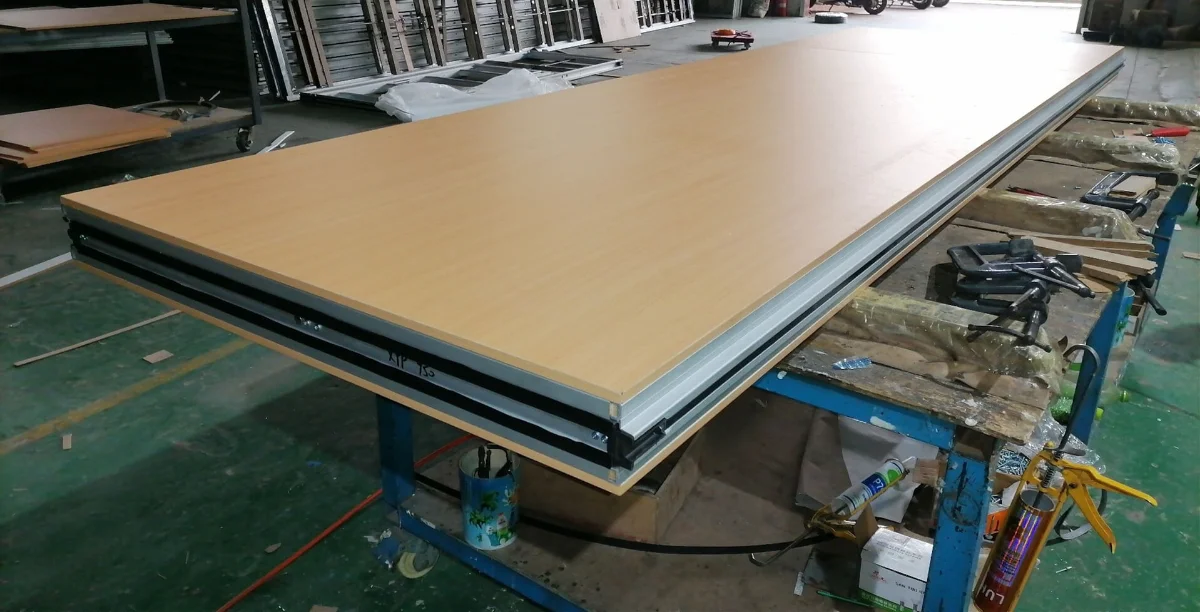
High STC comes from dense, layered panels and a complete perimeter sealing system. VersaWall panels combine a marine-plywood structure with high-density rock-wool infill, and retractable seals close the gaps at floor, ceiling and panel joints when the wall is shut.
A high lab STC can be undone on site
Rated STC assumes correct installation and complete seals. Skipped seals, gaps above the ceiling, or flanking paths around the wall will quietly erode real-world performance — which is why professional installation matters as much as the panel spec.
Common STC mistakes
- Undersizing: choosing STC 35 to save cost, then finding rooms aren’t private.
- Ignoring flanking: sound travelling over the ceiling or through ducts bypasses the wall.
- Forgetting seals: the best panel leaks if the perimeter isn’t sealed when closed.
Avoid all three by specifying the right rating up front and using an experienced supplier. Start with how to choose the right operable wall.
Frequently asked questions
What STC rating is considered good for an office partition?
STC 42 is the practical minimum for a private meeting room. For boardrooms, HR and confidential spaces, target STC 50 or higher, where normal speech becomes inaudible next door.
What does STC actually mean?
Sound Transmission Class is a single number rating how much airborne sound a wall blocks between two spaces. Roughly, an STC of 45 reduces sound by about 45 decibels — enough to turn loud speech into a faint murmur.
Is a higher STC always better?
Higher STC means more privacy, but you should match the rating to the space. General meeting rooms are well served by STC 42–45, while confidential rooms justify STC 50+. Over-specifying everywhere adds cost without benefit.
Specify the right STC for your space.
Get a tailored quote, or book a 30-minute demo to see the glide and acoustic seal for yourself.