How to choose the right operable wall for your office
One office, many configurations — but the right operable partition wall depends on far more than the width of the opening. Here is a practical framework, from acoustics to budget, to help you specify with confidence.
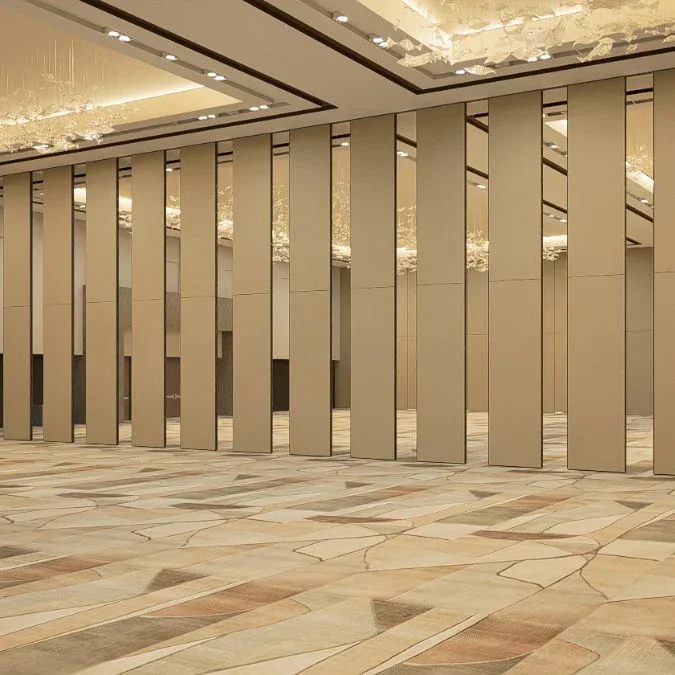
What an operable wall actually is
An operable wall — also called a movable, folding or sliding partition wall — is a series of acoustic panels suspended from an overhead track. They glide apart to open a space and draw together to divide it, letting one room work as several. Unlike a fixed wall, an operable wall is designed to be moved daily, by your own staff, in under a minute.
For offices, that flexibility is the whole point: a training room becomes two breakout spaces, a boardroom opens into a town-hall, and floor area that would otherwise sit idle earns its keep. The question isn’t whether an operable wall helps — it’s which specification fits how your team actually works.
The best operable wall isn’t the one with the highest numbers — it’s the one matched to how your space is used.
Start with how you’ll use the space
Before any spec sheet, map the behaviour. Two questions decide most of what follows:
How often will it move?
A wall that’s reconfigured several times a day demands an effortless glide and a durable roller system far more than one that closes for the occasional all-hands. Frequent movement favours lighter panels and a smooth, single-person operation.
Who operates it?
If facilities staff set up rooms, a heavier, higher-performance system is fine. If everyday employees reconfigure on the fly, prioritise intuitive, low-effort operation — top-hung panels on curved rollers that need no floor track and no special training.
Get the acoustics right
Acoustic privacy is the single most common reason operable walls disappoint — and it’s entirely avoidable. Sound isolation is measured by Sound Transmission Class (STC): the higher the number, the more sound the wall blocks.
What STC means in practice
- STC 25–30: normal speech is clearly audible — effectively an open plan.
- STC 42: loud speech is reduced to a murmur — the practical minimum for a private meeting room.
- STC 50+: normal speech is inaudible next door — appropriate for boardrooms and confidential conversations.
For most office meeting rooms, target at least STC 42; for executive and HR spaces, specify higher. You can see how each VersaWall platform performs on our acoustic performance overview, which ranges from 42 up to 56 dB.
Height, width & stacking space
Operable walls are top-hung, so the structure above the ceiling carries the load — not the floor. Three dimensions matter:
Panel height
Standard office floor-to-ceiling heights are easily covered, but double-height atriums, auditoriums and feature spaces need a system engineered for taller panels and heavier loads.
Opening width & track capacity
Wider openings mean more panels and more weight on the track — which is why track load capacity (kg/m) scales with the system. It’s a spec worth confirming early.
Stacking area
When open, the panels have to park somewhere. Plan a discreet stacking pocket — a recess, a cupboard, or against a return wall — so the parked wall doesn’t intrude on the open layout.
Finishes & aesthetics
An operable wall is one of the largest surfaces in the room, so its finish shapes the whole interior. Options range from acoustic padded fabric to tempered glass for borrowed daylight, melamine, and timber-look laminates. You can mix finishes across a single wall — glass at eye level, fabric below — to balance openness with privacy.
Explore the full range on our finishes guide and shortlist two or three that suit your palette before requesting a quote.
Doors, access & safety
Pass doors
If people need to move between divided rooms without folding the whole wall back, integrate a single or double pass door directly into a panel. It’s far more practical than reopening the partition every time.
Fire safety
Specify a wall with a fire-retardant core — VersaWall uses marine plywood with high-density rock-wool infill — so the partition contributes to, rather than compromises, your fire strategy.
Budget & lifetime cost
Price scales with height, acoustic rating, finish and track capacity — but the cheapest option rarely wins over time. A poorly engineered wall that’s hard to move gets used less, jams more and dates faster. Weigh three things:
- Daily usability — a smooth wall gets used; a stiff one gets left open.
- Durability — quality rollers and cores last decades, not years.
- Serviceability — confirm spare parts and warranty support locally.
Spend on the things you can’t change later
Acoustic rating and panel height are engineered in from day one — get them right. Finishes and doors are easier to tailor to taste, so let function lead and aesthetics follow.
Match your needs to a VersaWall model
Once you know your usage, acoustics and dimensions, matching to a system is straightforward. Every VersaWall shares the same curved-roller glide and fire-safe core; they differ in scale and acoustic performance.
Still unsure? Put them side by side on the model comparison, or tell us about your space and we’ll recommend one.
Your pre-quote checklist
Five things that speed up an accurate quote
- Opening dimensions — width and floor-to-ceiling height.
- Acoustic target — the STC level the space needs.
- Usage frequency — daily, weekly or occasional.
- Finish preference — fabric, glass, melamine or a mix.
- Pass door — needed, or not.
Frequently asked questions
What STC rating do I need for an office operable wall?
For private conversation in meeting rooms, aim for at least STC 42. Boardrooms and confidential spaces are better served by STC 50 or higher.
Can one person operate an operable wall?
Yes. A well-engineered top-hung wall on curved rollers can be opened or closed by a single person in under a minute, with no floor track.
How much space does an operable wall need when open?
Panels park in a stacking area when open, so plan a recess or return wall where the folded wall can sit discreetly out of the way.
Tell us about your space and we'll recommend the right wall.
Get a tailored quote, or book a 30-minute demo to see the glide and acoustic seal for yourself.