Types of partition walls in the Philippines: operable, folding, sliding and accordion
'Partition wall' covers everything from a glass screen to a 15-metre acoustic system. Here are the main movable types — operable, folding, sliding, accordion and demountable — and how to tell which one your space in the Philippines actually needs.
“Partition wall” is a broad term. In the Philippines it covers everything from a fixed gypsum stud wall to a 15-metre operable wall that splits a ballroom in minutes. If you’re comparing options, the first step is knowing the main movable types — because they differ hugely in acoustics, span and price.
Here’s a plain-English guide to the types of partition walls Filipino offices, hotels, schools and homes actually use, and how to tell which one fits your space.
Choosing a partition wall starts with one question: do you need to see a division, or to not hear through it?
What counts as a partition wall
A partition wall divides an interior space. It can be fixed (permanent — built once and never moved) or movable (designed to open and close so one room works as several). This guide focuses on the movable kind, since that’s where the real choice — and the confusion — lies. If you’re weighing movable against a permanent wall, see operable walls vs traditional room dividers.
The main movable partition types
A handful of movable types cover almost every project in the Philippines:
Operable (acoustic panel) walls
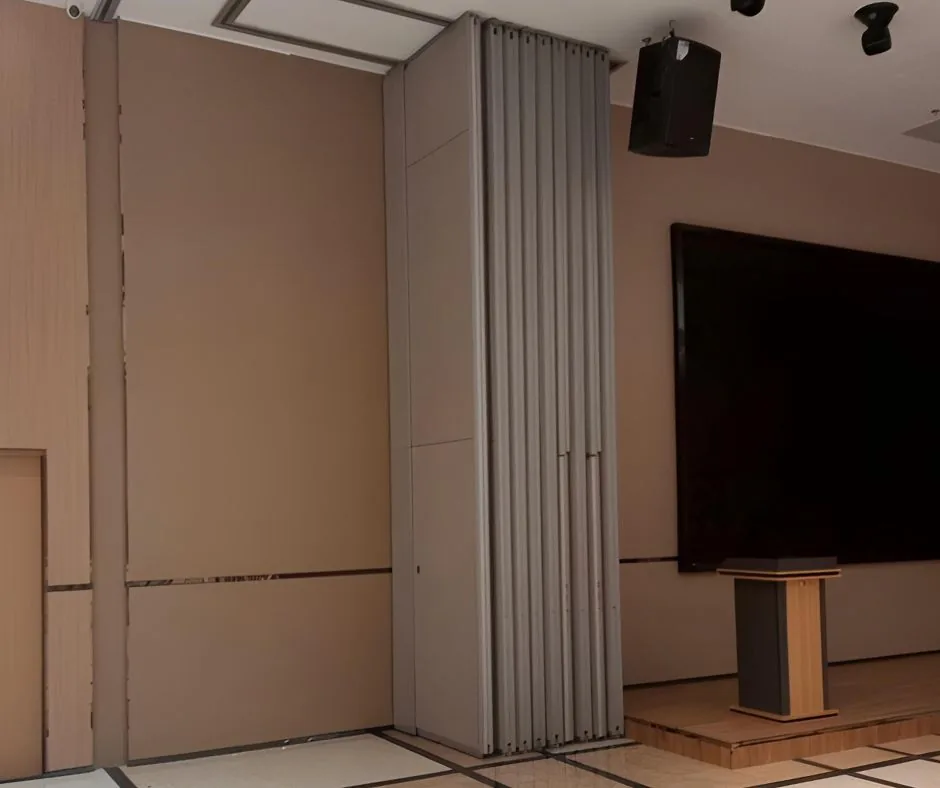
A series of individual, thick acoustic panels top-hung from an overhead track. Each panel moves independently and stacks away in a pocket, and a full perimeter seal delivers high sound insulation and tall spans (up to ~15 m). This is the premium option for privacy and scale — and what VersaWall builds.
Folding (accordion / concertina) partitions
A continuous run of hinged panels that concertina to one side. Simpler and lower-cost than a panelized system, but typically thinner with lower acoustic performance — fine for light, occasional division.
Sliding partitions
One or a few larger panels that slide along a track. Quick to operate and good for moderate openings, but limited in width and acoustics compared with a full operable system.
Demountable & glass modular walls
Framed modular or glass partitions that are semi-permanent — relocatable during a fit-out, but not opened daily. Great for visual division and borrowed daylight, weak on acoustic separation.
Operable vs folding vs sliding, at a glance
The trade-off is consistent: the more acoustic performance and span you need, the more you move toward a panelized operable system; the lighter and more occasional the use, the more a folding or sliding partition makes sense.
- Acoustics: operable (highest, to ~56 STC) > folding > sliding > glass/demountable.
- Span & height: operable handles the widest, tallest openings; sliding and folding suit smaller ones.
- Operation: all can be one-person; operable panels stack compactly out of sight.
- Looks & finishes: operable offers the widest finish range (fabric, timber-look, glass); glass partitions win on daylight.
- Cost: folding and sliding are cheaper up front; a panelized system delivers the lowest cost per year of real daily use.
For how sound rating is measured, see why STC matters.
Which type for which space
Match the type to the job — and the same logic holds whether you’re in Metro Manila, Cebu, Davao or Iloilo:
- Offices & meeting rooms — operable acoustic walls for private, dividable rooms; glass for light visual separation.
- Hotels & function halls — panelized walls to split ballrooms for simultaneous events.
- Schools & universities — acoustic partitions for classrooms and multipurpose halls.
- Homes & condos — sliding or folding partitions for light division; acoustic panels where quiet matters.
Why operable walls lead on acoustics & scale
If your space needs real privacy — exams beside each other, a boardroom, a wedding next to a conference — only a dense, panelized acoustic wall with a complete seal delivers it. That’s the gap between a true operable system and a basic folding partition: panel construction and perimeter seals are what stop sound, and they’re engineered in from day one.
Match a VersaWall model
Within operable walls, the platform scales with height and acoustic demand:
Compare all three on the VersaWall range.
How to decide
Start with the two things you can’t change later — acoustic target and span — then let finish and budget follow. Our how-to-choose guide walks the full framework, the cost guide sets the budget, and the supplier guide helps you pick a partner who can actually deliver and install it. When you’re ready, request a tailored quote.
Frequently asked questions
What’s the difference between an operable wall and a folding partition wall?
An operable wall is a series of individual acoustic panels top-hung from a track that stack away separately, giving high sound insulation and tall spans. A folding (accordion) partition is a continuous concertina of hinged panels — simpler and cheaper, but usually lower acoustic performance. For privacy and scale, operable walls lead.
Which is better, a sliding or a folding partition?
Sliding partitions move one or a few panels along a track and suit smaller, lighter openings; folding partitions concertina to clear a wider opening. Both are good for visual division; for genuine acoustic separation, a panelized operable acoustic wall outperforms either.
Which type of partition wall is the most soundproof?
A high-STC operable acoustic wall — dense, layered panels with a full perimeter seal — blocks far more sound than glass, sliding or basic accordion partitions. Ratings up to the mid-50s STC are achievable with operable systems.
What partition wall is best for an office in the Philippines?
For meeting rooms and dividable spaces that need quiet, an operable acoustic wall is the standard. For purely visual or light division, a glass or sliding partition may do. Match the type to the acoustic target and how often the wall moves.
Tell us about your space and we'll recommend the right wall.
Get a tailored quote, or book a 30-minute demo to see the glide and acoustic seal for yourself.